Mostrando postagens com marcador Brian Orser. Mostrar todas as postagens

quinta-feira, 13 de abril de 2017

World Championships 2017 - Yuzuru and Javier


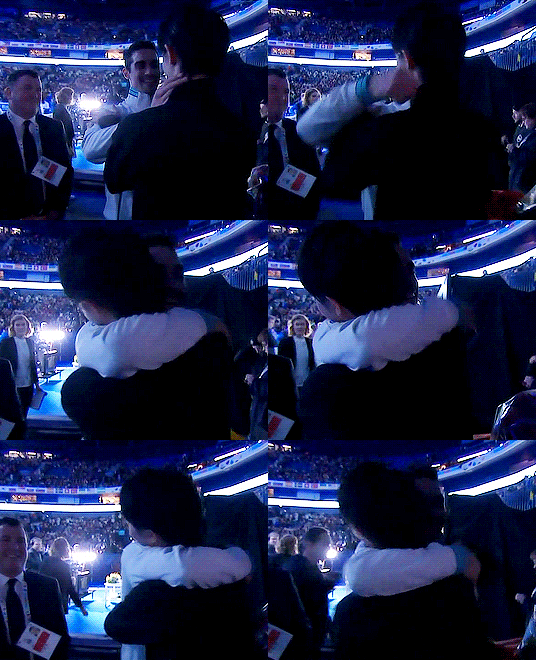
A few moments later, Hanyu arrived in the interview area, hugged Fernandez, removed the new shiny gold medal from his own neck and placed it around Fernandez’s.
The New York Times. 


Yuzuru and Javier hugging after Yuzuru’s win | ISU World Figure Skating Championships 2017


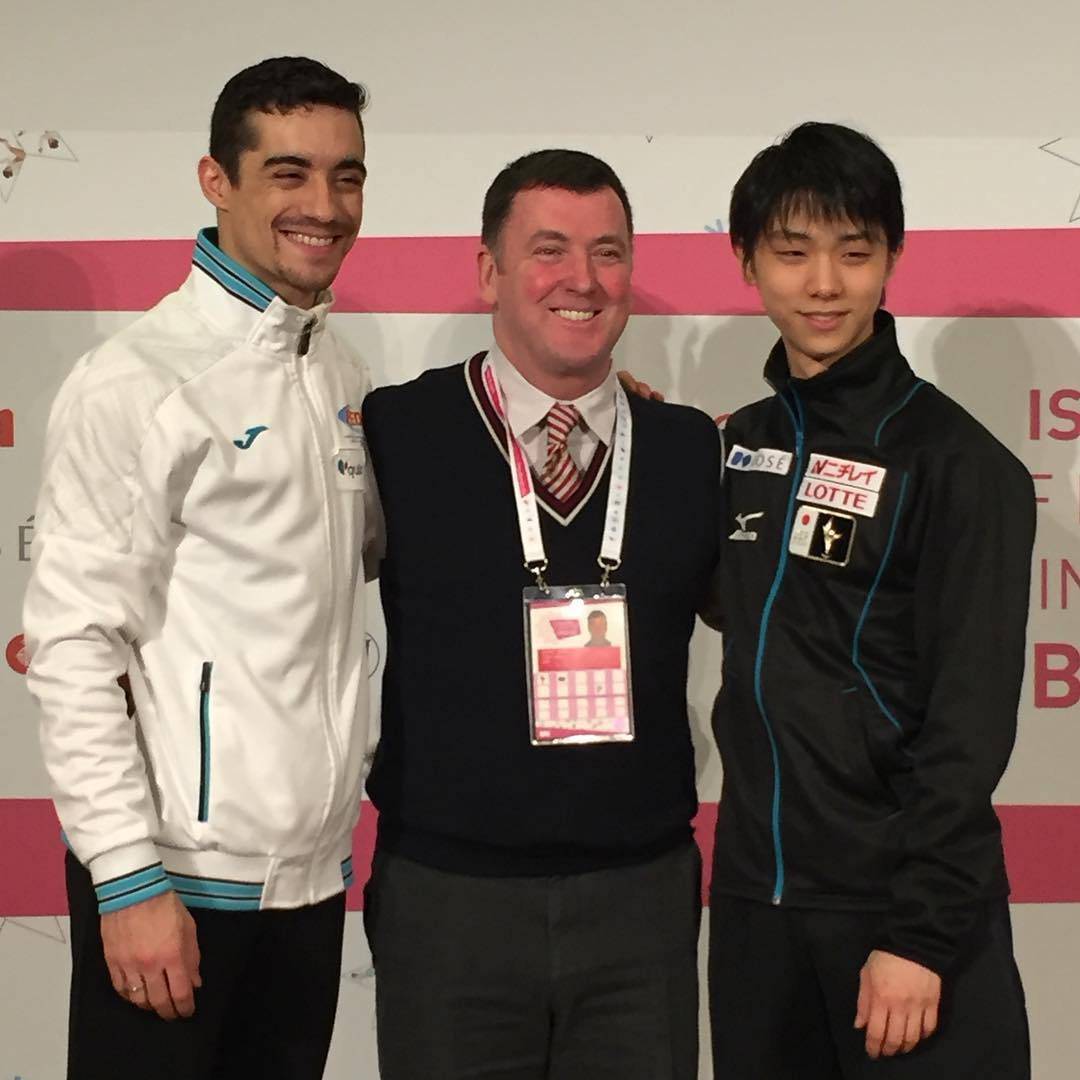
Brian Orser’s week at Worlds with skaters Yuzuru Hanyu and Javier Fernandez
nbcolympics.com


Source GIF: tanakakeiji.tumblr.

Source photos: twitter.com, cinnamonsmolyuzutumblr., flyingyuzu.tumblr., google

domingo, 13 de novembro de 2016

Entrevita Brian Orser - Yuzuru Hanyu

Overseeing Fernández, Hanyu a challenge for Orser
icenetwork

Coach elaborates on different approaches he takes with prized pupils

 Brian Orser is not one to hold back his emotions while watching his skaters compete. -Getty Images

One year ago, Javier Fernández reached a major technical milestone in his career, landing two quads in his short program. This season, Yuzuru Hanyu also reached a major milestone, landing a quad loop in each of his programs. On the eve of 2016 Trophée de France, Their common coach, Brian Orser, took time to answer some questions from icenetwork.

Icenetwork: You are training two world champions, who, instead of standing pat, are still improving. How do you manage to push them so much?

Brian Orser: I try to present things so that they become their ideas. When I see that the stars and moon are lined up, I feed the idea in, and then I let them take ownership of it. I prefer doing it that way rather than me saying, "You should do this." I don't have to take ownership. If skaters want to be competitive, if they are competitive, then they need to come up with the idea and do it.

Icenetwork: Yet Javier and Yuzu are so far ahead of their competitors. One year before the Olympics, they could have just worked on their artistry rather than their technique.

Orser: Those guys are in such good shape. Actually, they have a different strategy. Yuzu is still very young (he turns 22 on Dec. 7), and he feels like he needs to push the sport forward. Javi has a different mindset. He will be 26 at the next Olympics. He is quite content with what he has now. He has very high PCS (program components score), and that's what he needs to rely on. He is confident with his components. He is not at the point (where he feels he needs) to add new elements. From one Olympics to the next, you need to be more technical, of course, and that's what he did. But there is a point where you have to say, "OK." You have your elements, but you can always improve the way you execute them. GOEs (Grades of Execution) are where you win a competition. Plus-one's (+1's) are not enough; you need +2 or +3 across the board to win. When you skate a difficult step sequence perfectly, completely in line with the character of the program and your music, you get a Level 4, +3 GOE and high PCS. My skaters don't have to (rely) on doing so many quads, which may be the case with other skaters.

Icenetwork: Yuzuru has a different strategy, then?

Orser: Yuzu is very focused on his quads at the moment. There are six quads in his two programs this season, two of which are quad loops (one in the short and one in the free). He has really stepped it up technically this season. It's a tall order for him, and I needed some time to understand what his strategy was. He wants to use this season to get mileage on these new elements. That means that he had to sacrifice some of his skating at the start of the season. His speed, his spins, his elements were not so good at first, because he was focusing so much on the quads. His step sequence was maybe 70 percent of the level it should be. Once he explained his strategy to me, I totally understood. I understand Javier's strategy as well.

Icenetwork: Do you think that explains why Yuzuru lost at Skate Canada?

Orser: Skate Canada would have been an easy win for him, but he wanted to get some mileage with the quads. He is considering the bigger picture. Now he wants to train the program so the quads will be clean. He wants to feel good prior to the last quad (two of the quads are in the second part of his free skate). Later in the season, he will shift gears to go to a different mindset. The one who has to be patient is me! And the federation, of course, and the fans, who expect something perfect each time. But he is making me a believer.

Icenetwork: You will coach Javier in quite a different way, then, I suppose?

Orser: For Javier, I really have to train him on cardio, because he needs such good cardio to do what he does in his programs. He needs to remain true to his choreography and expression, because that's his thing. There is a real charm to his skating. He also needs a lot of energy for his transitions. They are fantastic, but they require an awful lot of work. You have to practice transitions a lot. For me, transitions aim at making skating look more effortless. They are used to make speed without charging through and use your body tension to create the move. Once Javier learned transitions, when he arrived in Toronto, the sky became the limit. For David Wilson, his choreographer, creating transitions for Javier is so cool.

Icenetwork: Do you encourage your skaters to devise a specific strategy?

Orser: Another interesting case is Elizabet Tursynbaeva (from Kazakhstan, who just took fifth place at the Rostelecom Cup). Her mindset is to add all the mileage she can, by skating more hours and doing four run-throughs a day. I'm trying to make her focus on "run-through days" instead of doing them every day. I want them to be nervous run-throughs, important ones. I want her to learn to breathe. Each run-through has to be "the one" and not "I'll do the next one." I want her to sleep on it the night before and think, "Tomorrow, I'll do a big girl long program." Skaters may drift away from their strategy, and they need us to put them back on track.

Icenetwork: Your skaters seem to have so much confidence in themselves. How do you build that in them?

Orser: You need to trust yourself and the work you've done. I don't want to go in and roll the dice. I need to know it's going to be a good, solid skate. I ask skaters to pay attention to their average. At first, their average is not so good, maybe 70 percent. As you go on through the season, your average should reach 95 percent, with a couple of 100 percents to take it even higher. When you go to competition, you can count on your average to produce something nice in a competitive environment. I hate being unprepared.

Icenetwork: Isn't that what happened to Javier in Boston (at the 2016 World Championships)?

Orser: Exactly! You know, Javier comes to the rink from Monday to Friday. He does his best run-throughs when he comes back from the weekend on Monday, after a two-day rest. In Boston, he could not practice at all between the short and the long program because of his heel. So that's what I told him before his long program: "That's your Monday!" -- even though it was Saturday. And he felt good about that. He skated his free program the way he would have skated it on a Monday -- at its best.

As a coach, there are always scenarios you need to be ready for, and have stories and anecdotes ready. They need to be ready, and they can't be fake. Last week, Javier didn't skate well in his short program. He drew to skate first in his group here (at Trophée de France), just like he drew first in Moscow. He doesn't like to skate first in a group. If we were to repeat the same pattern here in Paris, then he might think the result would be the same. We don't want that. So we have to do something different. We're going to implement a different strategy tomorrow. I can't tell you yet...we'll see tomorrow night if it works (he laughs).

Icenetwork: You are coaching two of the best skaters in the world. How do you manage it?

Brian Orser: It's hard. Don't believe all those who say, "Brian has so many good students -- he is so lucky!" It's really hard!

This is the first time Yuzu has been training most of the season in Toronto. Usually, he goes back and forth to Japan. So he is not used to me traveling to Junior Grand Prix or taking two weeks with Javier. This is what I usually do, of course, but he is not in Toronto to see it. He feels left out. In fact, if I look at the bigger picture, it's perfect that I am away. This way, he can work on his skating skills and choreography, which he needs. It will be the same for Javier when I go to NHK with Yuzu. He'll have a lot of new things to work on.

I try to be sensitive and aware of everyone's feelings and needs. I see the pressure building up as the Olympics are coming up. I'm glad I spent two weeks with Javier, as we've done great things. It was the same in Canada and will be again in Japan with Yuzu. He'll get all the attention.

We'll have to organize a group discussion with the whole team -- coaches, choreographers, skaters -- to define how we will move forward, how we can support them and give them the best advice. There has to be a good, positive community in our rink, where skaters can feel supported and safe. I would hate having one coach and his skaters, and then another coach and his own skaters. We try to create a harmony in the community we live in. I take things personally.


quarta-feira, 9 de dezembro de 2015

Grand Prix Final in Barcelona


Read more about Yuzuru in Barcelona here and here. 


  Graças a  aliajackson.tumblr novamente temos os horários dos eventos no horário local de várias cidades, além da contagem regressiva. Thanks Alia!

Programação de GPFBarcelona Homens e Gala

O sincronismo em fusos horários diferentes com base no cronograma de GPF e do relógio mundial.
Competição Masculina


 Cronômetros de contagem regressiva
- Homens Competição SP
- Competição Homens FP


Comemorando o aniversário de Yuzuru


2015 12 10 お誕生日ケーキ por yuzupinoko


Grand Prix Final podiums of the past 10 years - men:
Source: ohtheseskaters.tumblr
2005: 1. Stephane Lambiel (SUI) 2. Jeffrey Buttle (CAN) 3. Daisuke Takahashi (JPN)
2006: 1. Brian Joubert (FRA) 2. Daisuke Takahashi (JPN) 3. Nobunari Oda (JPN)
2007: 1. Stephane Lambiel (SUI) 2. Daisuke Takahashi (JPN) 3. Evan Lysacek (USA)
2008: 1. Jeremy Abbott (USA) 2. Takahiko Kozuka (JPN) 3. Johnny Weir (USA)
2009: 1. Evan Lysacek (USA) 2. Nobunari Oda (JPN) 3. Johnny Weir (USA)
2010: 1. Patrick Chan (CAN) 2. Nobunari Oda (JPN) 3. Takahiko Kozuka (JPN)
2011: 1. Patrick Chan (CAN) 2. Daisuke Takahashi (JPN) 3. Javier Fernandez (ESP)
2012: 1. Daisuke Takahashi (JPN) 2. Yuzuru Hanyu (JPN) 3. Patrick Chan (CAN)
2013: 1. Yuzuru Hanyu (JPN) 2. Patrick Chan (CAN) 3. Nobunari Oda (JPN)
2014: 1. Yuzuru Hanyu (JPN) 2. Javier Fernandez (ESP) 3. Sergei Voronov (RUS) 


Source Video: piece Fragment; @ISU_Figure
Source Gif: yuzu-ice.tumblr
Source photos: sukisukiyuzu.tumblr; sanspo.com;troublemakerstorm.tumblr; asahi.com

domingo, 22 de novembro de 2015

Brian Orser: We All Speak the Same Language of Figure Skating

Skating China by Heloise Xiao
 

The last spin ends amidst cheers and yells. In the centre of the rink stands one of the top skaters in men's figure skating field, gasping for air, surrounded by all the coaches, choreographers and athletes from Cricket Skating and Curling Club. Another skater comes to the ice, while the rest continue to cheer for him—'Come on! Push, push, you can do it!' Orser's eyes sparkle with excitement when he is describing the atmosphere in the Club. 'Everyone is helping each other. Normally it'll be easy just to stop, but everybody's clamping for him. He's grateful that we got through that first one. Then we do it again.'

From Orser's point of view, run-throughs are real tests. 'When you first start doing run-throughs, it's gonna be really ugly. You have to get into the trenches in this type of work. Bit by bit, day by day, week by week, the programmes get better. Then we work on sections. We have a different method, and it seems to work.'

While some Russian and Chinese coaches avoid overburdening their skaters with run-throughs, Orser and Tracy Wilson, the self-proclaimed 'old-school' North American coaches, believe in run-throughs. Yet he tries to make sure they are not too Spartan. One solution is to do run-throughs without doing big tricks. Jumping a triple Salchow instead of a quad Sal, the skater adapts to the same physiological system but reduces the risk of injury. Then he may ask his skaters to focus on the second half with usually easier jumps, although, in the case of his top skaters, the word 'easier' can mean a quad, two triple Axels, five jumps in total.

This kind of run-through does not last for the whole year. In the spring time of May and June, the Cricket Club concentrates on skating skills, practicing a lot of stroking without doing jumps or spins. The aim is not only to train skaters to fly across the ice, but also teach them how to cross one foot over the top of the other, to get the blade to accelerate. When time comes that they should practice spinning, he also teaches how to maximize the spins without having to work too hard. Afterwards, they add the new choreography to their practice schedule, getting familiar with new transitions while going on to polish skating skills. In summer, when the skaters are in good shape, they focus on new jumps, including new quads. The run-through starts halfway through the summer and is subject to everyone's schedule. Those whose competitions start earlier do run-throughs ahead of others. Orser wants his skaters to peak at the right time. His philosophy is that you have to push the skaters, chase them a little bit, but not train them too much.

(Photography by Zhong/Skating China)
 With the assistance of Tracy Wilson and other experts, Orser is ambitious to produce a whole package. 'Competing as a senior, you have to fill up the ice. You have to go fast. You have to have those Patrick Chan deep edges.' Great jumpers like Hanyu and Fernandez are now working arduously on skating skills and transitions. The typical difficult entries into quads apparently make their jumps less consistent for the moment, but Orser is confident in the benefits they bring. 'As soon as the new (scoring) system came on, I embraced it. I tried to figure out the best wisdom to get the most points.'

He feels less challenged than amazed by the Chinese wonder boy Boyang Jin, who a couple of days ago just landed quad Lutz-triple Toeloop combination in the short programme, attempted four quads in the long and eventually landed three (though there were weak landings). Jin's entries into his alien jumps were earthly, and he earned around 7 points for transition. Still, he posed a threat to the reigning World Champion at Cup of China, losing by less than 10 points. Brian would like his skaters to watch new talents like Jin, for it keeps them competitive. In the meantime, he boasts certain qualities of his own protégés. 'Javi and Yuzu have a little bit more maturity. We do capitalize on the transitions, but also on the elements where people can win and lose competitions, it is in the GOEs. So you need to do your own elements really well, including spins, steps, choreo steps. That's really where it makes a difference.'

Photography by Orange/Skating China
 Orser has good reason to feel confident. When Javier Fernandez came to Toronto in 2011, he was, in Orser's words, 'sloppy, out of shape', earning Level 1 or Level 2 for his 'terrible' spins. In just a few months, his component scores rocketed at Skate Canada. Brian is surprised on hearing how much he improved (16 points, contrasting Skate Canada with Worlds 2011), and attributes it to their patient work with Fernandez and good choreography of that season. The coaches 'smothered him with care', but polished him step by step, not dumping out information all at once, in case he should lose interest. After all, the Spaniard was a well-known lazy talent then. It was only when he lost his government funding and had to pay for his lessons that he treasured every moment on ice. 'I think it's the best thing that ever happened to him that now he was accountable for every dollar he was spending'.

Nam Nyugen, a rising star of Cricket Club, who sat in the fifth place at 2015 Worlds, is just on the same track. Armed with consistent jumps, these days the young Canadian champion has been training mostly to improve his spins, and also been planning to strengthen his transition in the near future. Yet Orser is patient with his growth as a skater and as a man. 'Yuzu and Javi took a long time. Nam needs to mature physically in order to do that.'

Speaking of the young Korean pupil Jun Hwan Cha, Orser is visibly appreciative. Having met and talked with him in a previous competition, Orser admitted that he was intrigued by Cha's techniques and genuine expression of his choreography, which was coming out of his body. 'Even though he's only thirteen, he really does skate like senior. I haven't been this excited for a long time.' The young boy broke his foot in the summer, but won the Autumn Classic Junior in October.

They have the potential, and the coaches trust them. Orser thinks his own reputation as two-time Olympic silver medalist would not make the judges trust his disciples. What makes a difference is that the skater delivers and comes up with something fresh. He thinks himself tough with the skaters. In the private rink, the situation can turn ugly when they do not deliver. 'I'm not always this nice. But Javi … And the same with Yuzu. They can get it and respect that approach.'

Despite the high technical criteria Team Orser is pursuing, the coach proposes passion as the most significant quality for a good skater. He teaches other skaters who will never be big champions as well, and enjoys their skating because they love to learn and express themselves, and that they are dedicated to skating. Once in a while, he sets up exercises for the skaters and looks at them in his office, finding them working hard even on their own. He feels fortunate with Yuzu, Javi, Nam, Elizabet just for their commitment, something that cannot be taught through lessons. Respect for everyone and communication are also crucial qualities. Orser likes to teach his athletes to be good people and have good manners.


quarta-feira, 12 de agosto de 2015

Yuzuru - treino aberto em Toronto - fotos

Leia a reportagem completa aqui  asahi.com.


sábado, 8 de agosto de 2015

Yuzuru - treino aberto em Toronto

Yuzuru  se encontrou com a imprensa, em Toronto, para responder algumas perguntas sobre a temporada 2015/2016.
A imprensa como todos os anos pode acompanhar um pouco da rotina de Yuzuru incluindo um treino, onde puderam observar alguns trechos dos programas que serão utilizados na  próxima temporada.
Esse encontro gerou várias notícias que repercutiram em todo mundo graças aos fãs de Yuzuru que sempre usam  a internet para replicar fotos, vídeos,  enfim tudo sobre Yuzuru. Obrigada por isso!


150807 トロント公開練習NEWS eve por YzRIKO


Fonte: パーシィ


Fonte: ちょこぴー
   
Fonte: yuzuaya1207

More vídeos:   yuzupinoko, YzRIKO, Japan Figure Skating

sexta-feira, 7 de agosto de 2015

Yuzuru Hanyu confirma o programa curto para a próxima temporada.

Yuzuru Hanyu conferma il programma corto della passata stagione

neveitalia.it

Presso il “Toronto Cricket Skating and Curling Club”, abituale sede di allenamento canadese, Yuzuru Hanyu ha incontrato i giornalisti sciogliendo alcuni dubbi riguardo il futuro.

Il campione olimpico in carica, smentendo le indiscrezioni circolate nelle ultime settimane, ha annunciato che riproporrà anche nella prossima stagione il programma corto coreografato da Jeffrey Buttle sulle note della “Chopin Ballade No.1”. Infatti, causa i ripetuti infortuni patiti tra autunno e inverno, è rimasto l’amaro in bocca per non essere mai riuscito a completare in gara il programma così come era stato inizialmente pianificato. L’obiettivo dichiarato rimane perciò quello di eseguire il quadruplo toeloop nella seconda metà della musica, collocando, invece, nella parte iniziale il triplo axel preceduto e seguito dalla luna.

Sul fronte del programma libero, era già stata ufficializzata da tempo la scelta di interpretare il tema “Seimei”, tratto dal film giapponese Onmyoji. In questo caso, la coreografia è stata curata da Shae-Lynn Bourne, come accaduto per il “Fantasma dell’Opera” presentato nella scorsa stagione.

Il debutto stagionale, a differenza del recente passato, avverrà in occasione  di "Skate Canada Autumn Classic International", che si terrà a Barrie in Ontario tra il 13 e il 15 ottobre. A distanza di due settimane, l’allievo di Brian Orser sarà ai nastri di partenza di "Skate Canada International", seconda tappa del Grand Prix ospitata per l’occasione dall’Enmax Centre di Lethbridge in Alberta.

Hanyu ha anche comunicato l’intenzione di ritirarsi dopo i Giochi Olimpici di Pyeongchang del 2018, puntualizzando come il target sia quello di bissare il successo di Sochi per chiudere la carriera con il secondo titolo individuale olimpico.

 Yuzuru Hanyu confirma o programa curto para a próxima temporada.

No "Toronto Cricket Skating e Curling Club," lugar habitual de treinamento canadense, Yuzuru Hanyu se reuniu com jornalistas para esclarecer algumas dúvidas sobre o futuro.

O campeão olímpico, negando rumores que circulam nas últimas semanas, anunciou que na próxima temporada  irá  apresentar
novamente o programa curto coreografado por Jeffrey Buttle para a melodia de "Chopin Ballade No.1". Na verdade, devido às repetidas lesões sofridas no outono e no inverno, Yuzuru  nunca foi capaz de  executar esse programa numa competição,  como  previsto inicialmente. O objetivo agora é, portanto,  executar o loop toe quadruple na segunda metade da música, colocando, em vez disso, no triplo axel inicial precedido e seguido pela lua.

Em termos do programa livre, já foi confirmado  a decisão de interpretar o tema "Seimei", baseado no filme japonês Onmyoji. Neste caso, a coreografia foi feita por Shae-Lynn Bourne, como aconteceu com o "Fantasma da Ópera", apresentado na última temporada.

A temporada de estréia, ao contrário do passado recente, terá lugar durante "Skate Canada International Autumn Classic", a ser realizada em Barrie, em Ontário entre 13 e 15 de Outubro. Depois de duas semanas, o estudante de Brian Orser estará na linha de partida de "Skate Canada International", a segunda etapa do Grand Prix hospedado para o Centro dall'Enmax ocasião de Lethbridge, em Alberta.

Hanyu também anunciou sua intenção de se aposentar após os Jogos Olímpicos de Pyeongchang 2018, apontando como a meta é repetir o sucesso de Sochi para encerrar sua carreira com o segundo título olímpico individual.  (Tradução Google Tradutor)


Read More:  
 nikkei.com
yahoo.co.jp
yahoo.co.jp
yahoo.co.jp
nikkansports.com
nikkansports.com
sanspo.com
47news.jp
asahi.com

domingo, 2 de agosto de 2015

Brian Orser de atleta a técnico campeão.

Getty Images
Puro talento e determinação combinada com um senso de musicalidade e criatividade, Brian OrserBrian Orser teve todo o pacote como um patinador competitivo internacional.

Nascido em 1961 e criado em Penetanguishine, Ontario, Orser começou a patinar quando ele tinha seis anos de idade. Em 1977, ele ganhou o novato patinagem Campeões do Canadá e dois anos mais tarde levou o primeiro prêmio no Campeonato Canadense Júnior. Além daquele ano, ele se tornou o primeiro Júnior e segunda pessoa  conseguir o triplo axel na competição.

Apelidado de "Mr. Triplo Axel ", ele também foi o primeiro patinador a pousar nas Olimpíadas. Ele ganhou uma medalha de prata para o Canadá no inverno jogo olímpico em 1984 e quatro anos mais tarde, ganhou outra de prata nos Jogos Olímpicos de Inverno em Calgary.

Em cima dessas conquistas, Orser foi oito vezes campeão nacional canadense de 1981 a 1988. Ele também ganhou o Campeonato Mundial em 1987, onde se tornou o primeiro competidor a executar dois eixos triplos no patim livre e três na mesma competição.


Em 1986, Orser alcançou uma das suas grandes honrarias - sendo condecorado como membro da Ordem do Canadá. É reconhecida não apenas sua habilidade como atleta, mas também sua contribuição como um embaixador não oficial do Canadá. No topo desta distinção, em 1990, ele ganhou um  Emmy por sua performance televisiva de Carmen on Ice.

Depois de dedicar uma carreira e estilo de vida para profissional de patinação artística, Brian Orser continua a mostrar a sua paixão pelo esporte artístico, compartilhando generosamente seu conhecimento com as próximas gerações de patinadores.

Em 2006, ele decidiu se aposentar das competições e dedicar-se totalmente ao treinamento. Ele levou tanto Kim Yuna (2010) e Yuzuru Hanyu (2014) para o ouro olímpico, juntamente com Javier Fernández para o título Mundial de 2015. Ele também foi o instrutor de patinação cabeça no Toronto Cricket Skating e Curling Club desde 2005. Orser continua hoje a treinar uma variedade de patinadores de medalhistas internacionais para jovens up-and-coming. (1)


Cada skatista tem uma personalidade única. Apesar das elevadas expectativas, Fernández,  tende a ser mais descontraído, enquanto Hanyu, é muito decidido sobre seu desejo de medalha.

"Com Javier, este ano nós não vamos a todos uma palavra a dizer repente, 'Você pode ser um medalhista olímpico." Nós vamos facilidade para ele da mesma forma que temos nos últimos dois anos e tentar mantê-lo relaxado e calmo ", disse Orser.

"Ele diz:" Eu vou tentar fazer o melhor que posso. " Essa é a maneira como ele pensa, "Orser observou. "Yuzuru quer ganhar."

Há muitos jovens skaters no rink a quem Orser dá entrada, mas para a temporada olímpica, ele está se concentrando a maior parte de seu tempo em Fernández, Hanyu e Nguyen.

"Eu sou melhor com embalagem e planejamento e encontrar uma programação de treinamento individualizado", disse Orser. "Eu não tenho uma maneira mesmice de fazer isso ... Eu acho que a psicologia de lidar com cada um desses atletas, você tem que personalizar o treinamento para cada um." (2) 

zimbio.com 

 Yuzuru Hanyu

 Para crescer mais como patinador Yuzuru tomou uma  decisão importante.

Ele decidiu deixar  Nananmi Abe que foi sua treinadora por muitos anos. Yuzuru escolheu Brian Orser como seu novo treinador.

Ele primeiro pensou em Orser quando leu um artigo numa revista de patinação. O artigo falava sobre Cricket Club de Orser em Toronto, e discutiu como ele possui um número de treinadores que se encarregam de diferentes aspectos das técnicas de patinação.

"Eu nunca tinha estado em um ambiente onde eu iria treinar ao lado de outros patinadores de primeira classe. Isso é o que me fez querer passar para Cricket Club. Eu quero estar pronto para Sochi. Vou sentir falta Nanami-sensei. Eu discuti isso com ela, e ela me deu sua bênção de todo o coração. Então, eu realmente quero trabalhar duro, para todas as pessoas que me apoiam, e especialmente para Nanami-sensei. "  (3)

news.xinhuanet.com
 Durante seu primeiro ano com Brian, foi relatado que Yuzuru faria freqüentes viagens a Toronto e continuam a frequentar o ensino médio em Sendai, no Japão.   Depois de se mudar para o Canadá, Yuzuru aumentou a sua formação on-gelo para 3-4 horas por dia, até 1-2 horas que tinha sido devido a uma combinação de tempo de gelo limitada em Sendai, escolaridade, e sua asma. 

Também durante esse primeiro ano com seu novo treinador, os resultados foram mistos, mas Yuzuru preso com ele. Brian tinha de se Yuzuru a entender que ele precisava aprender algumas habilidades básicas de patinação, a fim de ganhar o controle de sua velocidade e poder que ele era naturalmente dotado. Tendo ido de volta para o básico, você pode definitivamente ver que esta foi uma das áreas onde Yuzuru melhorou muito, treinando com Brian. Suas habilidades de patinação agora colocá-lo à parte do resto do mundo. Saltos de Yuzuru também tornaram-se agora mais consistente como ele aprendeu controle sobre a velocidade eo poder de sua patinação.


zimbio.com
Brian também tem ensinado Yuzuru como passear-se ao longo de seus programas. Esta tem sido a chave para Yuzuru dado suas lutas no passado com estar completamente exausto no final de seus programas. Sob equipe Brian de treinadores, Yuzuru também participa de fora formação de gelo, que está ajudando a melhorar a sua resistência e durabilidade.

Longe da superfície do gelo, Brian também é muito protetor de seus alunos. Brian entende a pressão de ser um campeão, e todos os pedidos e as exigências sobre o seu tempo. Ele guiou Yuzuru de sua própria experiência, e está tentando ensinar Yuzuru que ele está ok para dizer "não". Brian também tem ensinado Yuzuru a acreditar em si mesmo e sua formação. Acho Yuzuru sempre foi muito forte mentalmente, porém com Brian tutoria, ele tornou-se um dos concorrentes mais difíceis mentalmente no campo dos homens. Ok, talvez a teimosia de Yuzuru tem um pouco a ver com isso também! :)

Desde parceria com Brian, Yuzuru ganhou uma medalha de ouro olímpica, um Campeonato do Mundo, ganhou de volta para trás Grand Prix campeonatos finais, e tem 3-vem ser repetidas no Japan Nationals. (4)

@master_chel
 Espero que a parceria Yuzuru/Brian continue e renda muitos frutos  ainda. Lógico que falo entre  outras  coisas de ganhar a Olimpíada, mas também gostaria de vê-los juntos acumulando conquistas e realizações depois da aposentadoria de Yuzuru.
Brian e Yuzuru poderiam trabalhar juntos treinando e aconselhando jovens promessas da patinação além de continuar a divulgar o esporte pelo mundo.  

(1) Parte integrante do artigo: Sports Hall of Fame do Canadá - Perfil: Brian Orser
(2) Parte integrante do artigo: Orser preps students, psyche for Olympic season
(3) Parte integrante do artigo:Yuzuru Hanyu interview.  transcrito por yoko71.tumblr
(4) Parte integrante do artigo:  Brian Orser: Uma lenda, construindo outra lenda.

Traduzido pelo google Tradutor. 

This blog is a summary of some facts of life and skater Yuzuru Hanyu career. The idea came from not find almost anything here in Brazil about Yuzuru and / or skating , but when searching the world discovered so things became difficult absorb and organize all ; hence this blog was born .